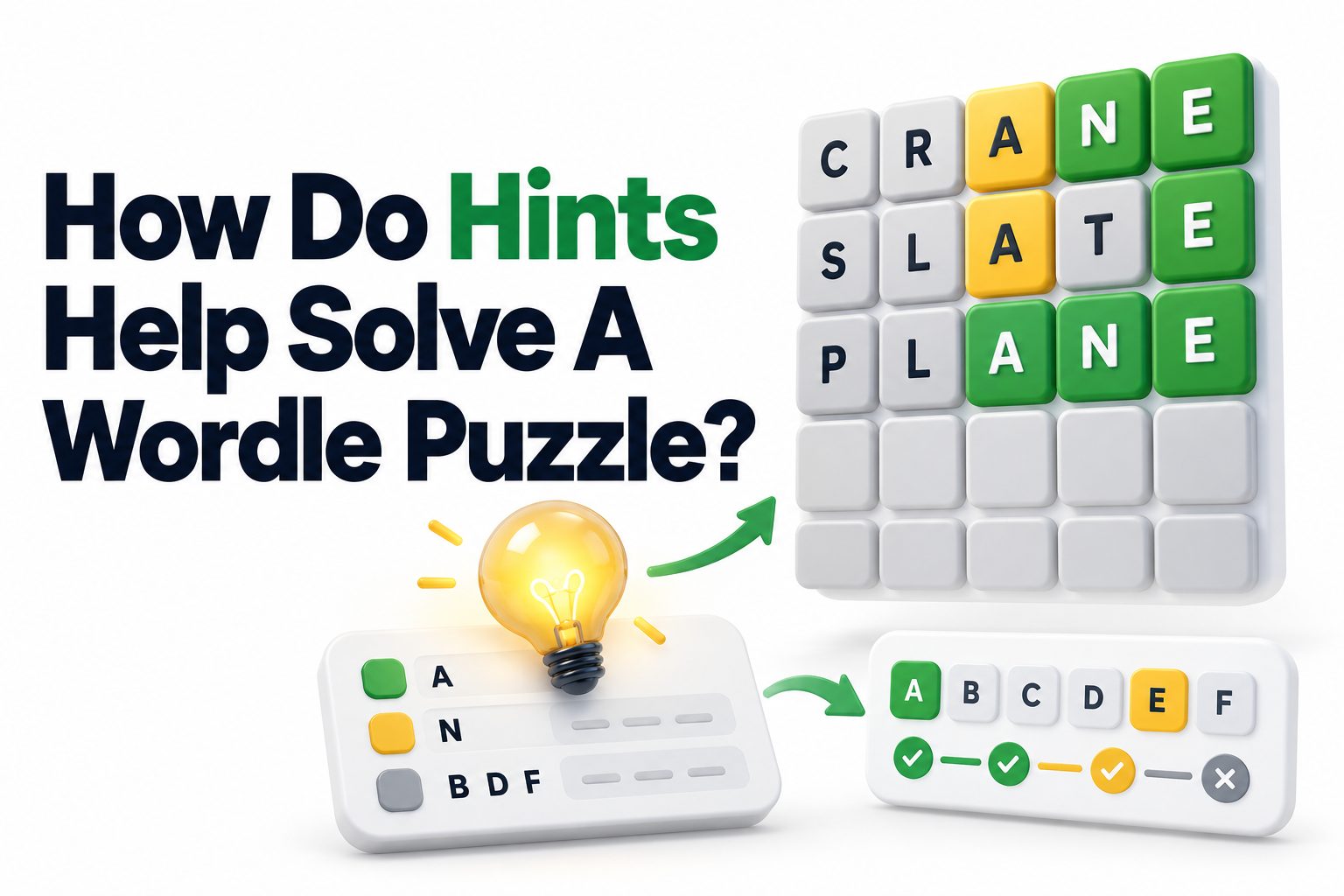
Wordle hints reduce uncertainty by showing which letters belong in the answer, where those letters may appear, and which possibilities can be eliminated. Used well, they turn a broad guessing game into a focused process of deduction. The key is treating every hint as evidence rather than simply searching for a word that includes a few confirmed letters.
So, how do hints help solve a Wordle puzzle in practical terms? Green tiles lock letters into exact positions, yellow tiles confirm letters while ruling out specific positions, and gray tiles usually remove letters from consideration. External hints may also reveal the word’s meaning, first letter, vowel count, or repeated-letter pattern. Each clue narrows the list of possible answers.
This article explains how to interpret those clues, choose productive guesses, handle repeated letters, and avoid wasting attempts. You will also see practical examples of turning color feedback into a solution without spoiling the puzzle. By the end, you should be able to use hints strategically while preserving the challenge that makes Wordle satisfying.
What Wordle Hints Actually Tell You
Every Wordle guess produces information through colored tiles. A green tile means the letter is correct and placed correctly. A yellow tile means the answer contains that letter, but not in the tested position. A gray tile generally means the letter does not appear in the answer.
These colors do more than rate a guess. They create rules that every future guess should follow. If the second letter is green, it should normally remain fixed. If a letter turns yellow in the fourth position, it belongs somewhere else. Gray letters should usually be excluded.
Hints may also come from outside the game. A Wordle helper, a friend, or a daily clue page might reveal the word’s category, first letter, number of vowels, or presence of a double letter. Such hints vary in strength, so they should be interpreted alongside the board’s confirmed evidence.
Why Hints Make Wordle Easier to Solve
A five-letter answer can feel difficult when almost every letter remains possible. Hints shrink that search space. Confirming even one vowel and one consonant can remove hundreds of unsuitable words, especially when their positions are also partially known.
Hints also help players choose guesses based on information rather than instinct. Instead of trying the first word that comes to mind, you can test unresolved positions, introduce unused letters, and compare candidates against every clue already received.
The strongest benefit is not that hints provide the answer immediately. They organize the puzzle. Good clues reveal what must be true, what cannot be true, and what still needs testing. That structure makes later guesses more deliberate and less dependent on luck.
Key Benefits of Using Wordle Hints
- They reduce the number of plausible five-letter words.
- They identify confirmed letters and fixed positions.
- They prevent repeated use of eliminated letters.
- They expose missing vowels or important consonants.
- They help distinguish between several similar candidates.
- They reveal when a repeated letter may be present.
- They encourage evidence-based guessing rather than random attempts.
- They can prevent a promising pattern from becoming a guessing trap.
Types of Hints You May Encounter
Not all Wordle hints work in the same way. Some come directly from the game, while others provide optional assistance. Knowing the difference helps you decide how much support to use without removing the puzzle’s challenge.
Color Feedback
Color feedback is the core hint system. Green, yellow, and gray tiles report how the letters in your guess relate to the hidden word. These hints are always available and form the basis of logical Wordle solving.
Positional Clues
A positional clue identifies where a letter belongs or does not belong. Green tiles provide positive positional information. Yellow tiles provide negative positional information by showing that a confirmed letter cannot occupy the tested square.
Letter-Based Clues
Some hint sources reveal a starting letter, ending letter, vowel, or uncommon consonant. These clues can be especially useful when the board still permits many possible words. A single well-chosen letter may connect previously disconnected pieces of evidence.
Meaning and Category Clues
A semantic hint describes the answer without spelling it. It might say that the word relates to cooking, movement, emotion, clothing, or nature. This style preserves more of the solving process because the player must connect meaning with the available letter pattern.
Structural Clues
Structural hints describe the word’s construction. Examples include revealing that the answer has two vowels, contains a repeated consonant, ends with a common suffix, or uses an unusual letter combination. These clues are particularly valuable when the board appears nearly solved but several candidates remain.
Reading Green, Yellow, and Gray Tiles Correctly
Green tiles provide the clearest information. Once a letter turns green, keep it in that position unless you intentionally use a separate information-gathering guess. Moving a known green letter usually wastes information because its location has already been established.
Yellow tiles require more attention. A yellow letter must appear in the answer, but it cannot stay in the position where it was tested. Multiple yellow letters should be rearranged while respecting every excluded position from earlier guesses.
Gray tiles are usually eliminated, but repeated letters create an important exception. If a guess contains the same letter twice and only one copy receives color, the answer may contain one instance rather than none. The gray copy is reporting excess usage, not necessarily total absence.
Wordle Color Comparison
Green
Meaning: The letter is in the answer and in the correct position.
Best response: Keep it fixed in future candidate words.
Common mistake: Moving it unnecessarily to test another arrangement.
Yellow
Meaning: The letter is in the answer but placed incorrectly.
Best response: Test it in a position not previously ruled out.
Common mistake: Reusing it in the same known-wrong position.
Gray
Meaning: The letter is absent or appears fewer times than guessed.
Best response: Remove it unless duplicate-letter feedback suggests one copy remains possible.
Common mistake: Treating every gray duplicate as proof that the letter is completely absent.
Turning Color Feedback Into Useful Constraints
The most reliable way to solve Wordle is to convert each colored tile into a clear constraint. Suppose you guess CRANE and receive a green R, a yellow A, and gray tiles for C, N, and E. You now know the second letter is R, A appears somewhere other than the third position, and C, N, and E are unlikely to appear.
A weak follow-up guess might ignore those facts or reuse several gray letters. A stronger guess would preserve R in position two, move A elsewhere, and test useful unused letters. The goal is to satisfy known constraints while collecting new information.
Keep a simple mental pattern for the answer. In this example, the pattern begins “_ R _ _ _,” includes A outside position three, and excludes C, N, and E. Thinking in patterns prevents attractive but impossible words from distracting you.
A Practical Method for Using Hints
Hints become most useful when handled in a consistent order. The following process works with both the game’s color feedback and optional outside clues.
1. Record every confirmed position
Place green letters into a five-space pattern. If the fourth tile is green T, write or visualize “_ _ _ T _.” Fixed letters sharply limit which candidate words can fit.
2. Track yellow letters and blocked positions
List each yellow letter along with the position where it cannot appear. A yellow S in position one means S belongs in positions two through five, subject to any other exclusions.
3. Remove gray letters carefully
Exclude gray letters from candidate words, but first check whether the guess included duplicates. When one copy is colored and another is gray, the answer may contain exactly one copy.
4. Combine outside hints with board evidence
If a clue says the answer relates to music, do not brainstorm every musical word. Search only for musical five-letter words that match the confirmed positions and remaining letters.
5. Choose a guess with a clear purpose
Decide whether the next attempt is meant to solve the puzzle or gather information. A solving guess should be a plausible answer. An information guess may test several useful letters even when it cannot be the solution.
6. Recheck all earlier clues
Before submitting, compare the word with every green, yellow, and gray tile. This brief check prevents avoidable contradictions and is especially important when Hard Mode requires confirmed clues to be reused.
Choosing the Best Next Guess
A useful next guess should either be a realistic answer or separate several realistic answers. Early in the game, words containing common vowels and consonants tend to reveal more information than words with repeated or uncommon letters.
Later guesses require a different approach. Once you have a pattern such as “_ I G H T,” guessing MIGHT may solve the puzzle, but it provides limited protection if LIGHT, NIGHT, RIGHT, and FIGHT are also possible. You may need to test their starting letters strategically.
An information guess can help when many candidates differ in only one position. A word containing several of the possible starting letters may identify the correct family member more efficiently than guessing candidates one at a time. This tactic is not always allowed in Hard Mode.
For more detail on choosing productive opening words, see [Internal Link: Best Starting Words for Wordle].
Managing Repeated Letters
Repeated letters are among the most common causes of confusion. Players often assume that each answer uses five different letters, but Wordle solutions can contain double letters. A word such as SHEEP, ARRAY, or BLOOM requires the solver to consider the same letter more than once.
The color system reveals quantity indirectly. Suppose you guess SPEED against an answer containing one E. One E may receive green or yellow feedback while the other turns gray. That combination usually indicates that the answer contains one E, not two.
Repeated letters become more likely when all common alternatives have been eliminated. If four positions seem constrained but no ordinary candidate fits, test whether a confirmed letter appears twice. This possibility is especially important near the end of a puzzle.
Common Hint-Reading Mistakes
- Reusing a yellow letter in the same position where it already failed.
- Forgetting that one gray duplicate can coexist with one colored copy.
- Discarding a letter completely after mixed duplicate-letter feedback.
- Choosing words that contradict a confirmed green tile.
- Treating a meaning clue as more reliable than direct board feedback.
- Assuming every answer contains at least two different vowels.
- Testing rare letters before common possibilities have been eliminated.
- Guessing one candidate at a time when several words share the same pattern.
- Using an outside hint without checking whether it matches the current board.
- Entering a familiar word simply because it looks close to the pattern.
Using Hints Without Spoiling the Puzzle
Hints are most satisfying when they provide the minimum assistance needed to restart your reasoning. Rather than revealing the answer, a good hint points toward the next deduction. It might identify a word category, confirm a repeated letter, or highlight a tile you have interpreted incorrectly.
A tiered approach preserves the challenge. Begin with the board alone. If you become stuck, request a broad semantic clue. Next, ask for structural information, such as the vowel count. Use a specific letter or position only when broader clues are not enough.
You can also set a personal limit before starting. For example, allow one clue after the fourth guess or permit only category-based hints. Clear rules prevent repeated clue-seeking from turning the puzzle into simple answer retrieval.
Hints are tools, not requirements. Some players enjoy solving without outside assistance, while others use clues to learn better deduction habits. Neither approach changes the basic goal: interpreting available information and finding the answer within six attempts.
Troubleshooting When a Hint Seems Wrong
When a clue appears to conflict with the board, review the direct color feedback first. A common source of confusion is a duplicate letter. The game may color one copy yellow and another gray because the answer contains only one instance.
Position tracking can also cause apparent contradictions. A letter may have been tested in several places and ruled out from each, leaving only one legal position. Writing down the five-slot pattern often reveals a placement that is easy to overlook mentally.
External hints may be broad, subjective, or poorly phrased. A clue describing the answer as “related to movement” could refer to an action, an object that moves, or a result of motion. Treat semantic clues as guidance rather than exact definitions.
If no candidate fits, rebuild the evidence from the beginning. Check the spelling of previous guesses, review each tile, and separate confirmed facts from assumptions. Solvers often remember a yellow tile as green or unconsciously eliminate a letter that was never tested.
Hint Troubleshooting Checklist
1. Confirm every green letter and its exact position.
2. List each yellow letter and all positions where it failed.
3. Review guesses that used the same letter more than once.
4. Separate gray letters from gray duplicate copies.
5. Check whether the proposed word is a valid five-letter entry.
6. Compare external clues with the board rather than using them alone.
7. Reconsider assumptions about vowel count and repeated letters.
8. Test whether several candidates share one unresolved position.
Hard Mode and Hint Strategy
Wordle’s Hard Mode requires players to use revealed hints in subsequent guesses. Confirmed green letters must remain in place, and yellow letters must generally be included. This prevents some broad information guesses that ignore the current pattern.
The mode rewards careful candidate selection. Each guess must respect known evidence while still testing unresolved letters. A word that uses confirmed clues and introduces two or three new characters is usually more valuable than one that repeats letters without a specific reason.
Hard Mode can create difficult word-family situations. When several candidates share four letters, you may be forced to guess them sequentially because a separate elimination word would violate the rules. Saving attempts becomes more important, especially with endings such as “ATCH,” “OUND,” or “IGHT.”
Before enabling the mode, decide which experience you prefer. Standard play offers more freedom for strategic elimination. Hard Mode places stricter emphasis on direct deduction. Both benefit from accurate hint interpretation, but the available tactics differ.
Standard Mode and Hard Mode Comparison
Standard Mode
Confirmed letters: May be temporarily omitted.
Elimination guesses: Fully available.
Best use: Testing several candidate letters at once.
Main advantage: Greater flexibility when facing a word family.
Main limitation: Easy to waste a guess that contributes little to the final pattern.
Hard Mode
Confirmed letters: Must be reused according to revealed clues.
Elimination guesses: Limited by existing information.
Best use: Building valid candidates from current evidence.
Main advantage: Encourages disciplined use of hints.
Main limitation: Similar candidate words may need to be tested individually.
Balancing Information and Solution Attempts
Every Wordle guess serves one of two purposes: collecting information or attempting the solution. Early guesses usually emphasize coverage. They test common letters, identify vowels, and establish a rough structure. Later guesses should increasingly reflect the known pattern.
The transition matters. Continuing to use broad test words after enough evidence exists can waste attempts. Conversely, attempting a low-probability solution too early may reveal less than a balanced word containing five useful letters.
Ask what each guess will teach you if it is wrong. A productive attempt should clarify positions, eliminate competing candidates, or test a suspected duplicate. If a guess would leave the puzzle almost as uncertain as before, choose another word.
Strong play does not require calculating every possibility. It requires a clear reason for each attempt. Even a failed guess is valuable when its result sharply reduces the remaining answer set.
Practical Example of Solving With Hints
Imagine your opening guess is SLATE. The S and E turn gray, L becomes yellow, A is green in position three, and T becomes yellow. Your current structure is “_ _ A _ _.” The answer contains L and T, but L is not second and T is not fourth.
Next, you guess UNTIL. Suppose U, N, and I turn gray, T becomes yellow again in position three, and L turns green in position five. You now have “_ _ A _ L,” with T required in position one or two because positions three and four have been ruled out.
A likely candidate might be TRAIL, but I has already been eliminated and L must remain fifth. The word TRawl would be invalid because it contains the wrong arrangement and spelling. Continuing carefully, you would search for a valid five-letter word matching the exact constraints rather than forcing the nearest familiar pattern.
This example shows why hints must be combined. No single tile solves the puzzle. The answer emerges from fixed positions, excluded positions, eliminated letters, and the set of valid words that remains.
Do and Don’t List for Better Hint Use
Do
- Keep a mental or written record of blocked yellow positions.
- Use common unused letters when the board remains open.
- Consider duplicate letters when ordinary candidates fail.
- Check every clue before submitting a guess.
- Use broad outside hints before requesting specific letters.
- Choose guesses that distinguish between multiple candidates.
Don’t
- Treat yellow as meaning the letter is almost correctly placed.
- Reuse gray letters without a deliberate reason.
- assume all five letters must be different.
- Let a semantic clue override direct tile evidence.
- Request the entire answer when a smaller hint would be enough.
- Spend several attempts testing nearly identical words unnecessarily.
Building Better Wordle Skills Over Time
Regular practice makes color patterns easier to interpret. You begin recognizing common letter combinations, likely endings, and productive consonants. This knowledge reduces the time spent considering words that technically fit a few tiles but are structurally unlikely.
Reviewing difficult puzzles is especially useful. After solving, identify which clue mattered most and where an earlier guess could have tested more valuable letters. This turns each game into practice for future puzzles rather than an isolated win or loss.
Vocabulary helps, but deduction matters more. A large word list is useful only when candidates are filtered correctly. Players who track positions and exclusions carefully often outperform those who know more unusual words but guess without a plan.
You can also study [Internal Link: Common Wordle Letter Patterns] to become more familiar with frequent beginnings, endings, and consonant clusters. Pattern knowledge should support the tile evidence, not replace it.
Conclusion
Hints help by converting a Wordle board from an open-ended vocabulary challenge into a manageable set of letter and position constraints. Green tiles establish fixed placements, yellow tiles confirm letters while excluding locations, and gray tiles remove possibilities unless duplicate-letter feedback indicates a limited count.
The most effective approach is to combine all available evidence before every guess. Preserve confirmed positions, move yellow letters into legal spaces, avoid eliminated characters, and consider repeated letters when no ordinary candidate works. When several answers share a pattern, use a guess that separates them efficiently rather than testing each one blindly.
Outside clues are most rewarding when used gradually. A category, vowel count, or structural hint can restore momentum without giving away the solution. Direct letter reveals should be saved for situations where broader guidance is not enough.
Ultimately, how do hints help solve a Wordle puzzle comes down to disciplined elimination. Each clue reduces uncertainty, and each well-planned guess turns that reduced uncertainty into progress. Treat the colors as rules, give every attempt a purpose, and the final answer becomes much easier to identify.
Frequently Asked Questions
Can Wordle hints reveal repeated letters?
Yes. Mixed feedback for duplicate letters can indicate how many copies appear in the answer. If one copy is colored and another is gray, the solution often contains the letter once rather than twice.
What is the most useful Wordle hint?
A confirmed letter position is usually the most useful because it restricts both the letter and its location. Structural hints, such as a repeated letter or vowel count, can also sharply reduce possible answers.
Should gray letters always be eliminated?
Usually, but not automatically. When a guess contains duplicate letters, one copy may turn gray because the answer contains fewer copies. Review all tiles for that letter before removing it completely.
When should an outside hint be used?
Use an outside hint when your current evidence produces too many candidates or no clear next step. Start with a broad category or structural clue before requesting a specific letter or position.
Do hints work differently in Hard Mode?
The color meanings stay the same, but Hard Mode requires revealed clues to be used in later guesses. This limits broad elimination words and makes careful candidate selection more important when several answers share a pattern.