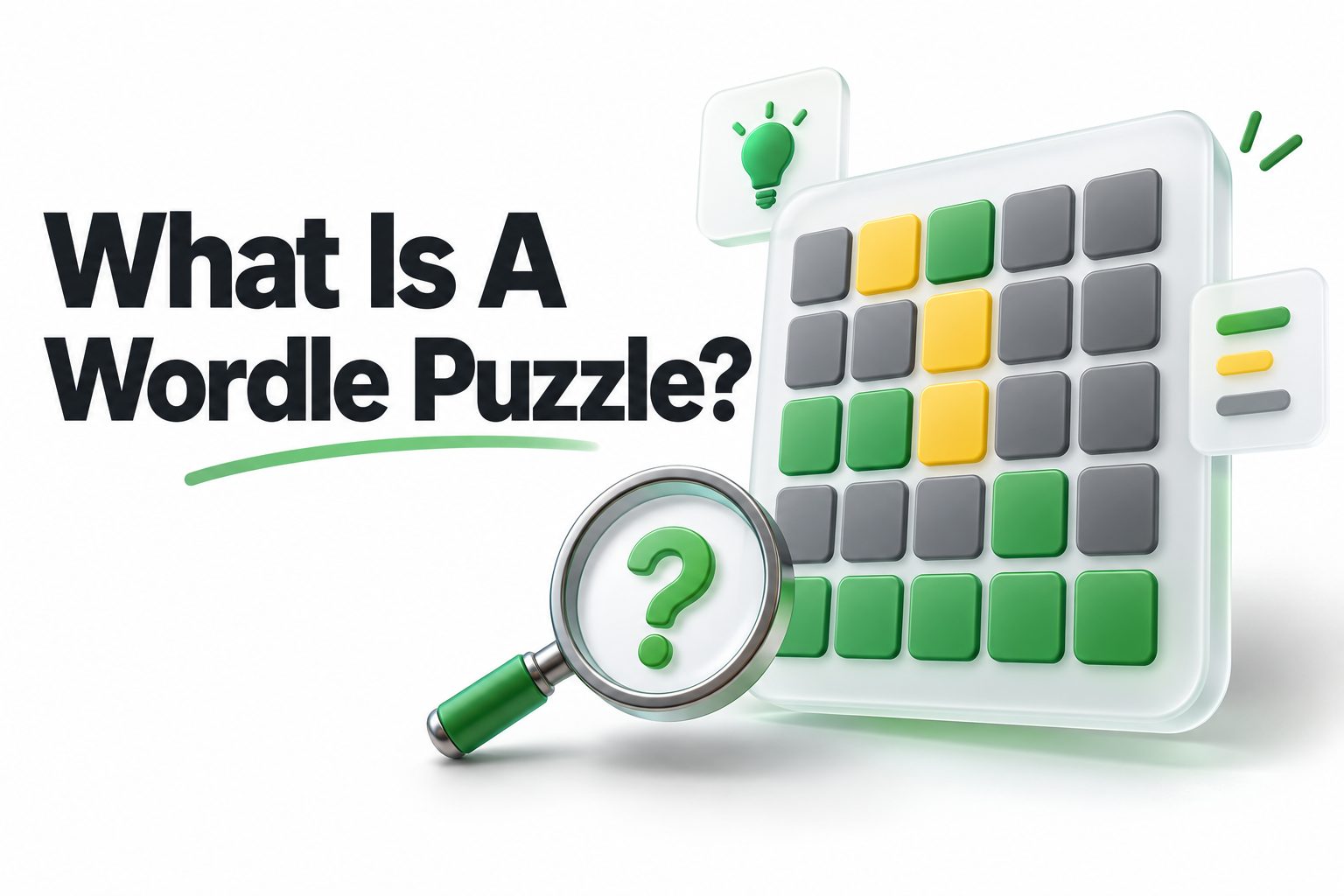
Wordle looks simple: six rows, five empty squares, and one hidden word. Yet those few boxes create a surprisingly absorbing test of vocabulary, logic, and decision-making. So, what is a Wordle puzzle? It is a daily word game in which players have six attempts to identify a five-letter word. After each guess, colored tiles reveal whether the letters are correct, misplaced, or absent from the solution.
The objective is not merely to think of possible words. Each guess should use the available clues to narrow the remaining options. A strong player pays attention to letter positions, repeated letters, common spelling patterns, and the information already eliminated.
This article explains how Wordle works, what each tile color means, and how to solve a puzzle step by step. You will also learn practical opening strategies, common mistakes, repeated-letter rules, useful alternatives, and ways to improve without relying on spoilers. By the end, you will be ready to approach each daily grid with a clear, efficient method.
What a Wordle Puzzle Is
A Wordle puzzle is a word-guessing game built around one hidden five-letter answer. You enter a valid five-letter word, receive color-coded feedback, and use those clues to make a better guess. You win by finding the answer within six attempts.
The original daily format gives everyone the same puzzle and generally limits players to one new challenge per day. That shared answer encourages people to compare results without revealing the word. Many unofficial versions also offer unlimited games, themed vocabulary, or words of different lengths.
The Basic Objective
Each row represents one attempt, while each square holds one letter. When you submit a guess, the game evaluates every letter against the answer. The tiles then change color, showing which parts of your guess should be kept, moved, or discarded.
A successful solve requires both vocabulary and deduction. You may know thousands of five-letter words, but only a small number will fit the clues after several rounds. The real challenge is choosing guesses that reduce uncertainty while still having a realistic chance of being correct.
Wordle Rules and Tile Colors
Wordle uses three feedback colors. A green tile means the letter is correct and already in the right position. A yellow tile means the answer contains that letter, but it belongs elsewhere. A gray tile usually means the letter is not present in the answer.
Colors may vary when a player enables a high-contrast or colorblind setting, but their functions remain the same. Because accessibility palettes can differ between versions, it is more useful to remember the meanings—correct, misplaced, and absent—than to rely solely on specific shades.
Green Tiles
A green tile confirms both the letter and its location. If the first letter in your guess turns green, every later candidate should normally begin with that letter. Moving a confirmed letter wastes information unless you are deliberately testing possibilities in a separate practice tool.
Green letters provide the strongest clues, but they do not always make the answer obvious. A pattern such as “_IGHT” can still match several words. When multiple candidates remain, test the uncertain letters instead of repeatedly guessing similar answers one at a time.
Yellow Tiles
A yellow tile confirms that the letter appears somewhere in the answer, but not in the tested position. The next guess should place it in another available square. A yellow letter can sometimes appear more than once, although the clue alone does not prove duplication.
Yellow clues are easy to misuse. Players often remember that a letter belongs in the word but accidentally return it to a position already ruled out. Reviewing every previous row before submitting a guess prevents this avoidable error.
Gray Tiles
A gray tile usually eliminates that letter from future guesses. Once a letter has been ruled out, replacing it with an untested character gives you more information. Reusing several confirmed-absent letters usually makes a guess inefficient.
Repeated letters create an important exception. One copy of a letter may be green or yellow while another copy appears gray. In that situation, the gray tile generally indicates that the answer contains fewer copies than the guess, not that the letter is entirely absent.
Key Tile Meanings
- Correct-position tile: Keep the letter in the same square.
- Misplaced-letter tile: Keep the letter, but move it to another position.
- Absent-letter tile: Avoid the letter unless duplicate-letter feedback gives you a reason to reconsider it.
- Mixed duplicate feedback: Count confirmed copies carefully before deciding whether the answer contains the letter once or multiple times.
How to Play Wordle Step by Step
Begin by opening the official game or another Wordle-style puzzle. Type a valid five-letter word and submit it. The board evaluates your entry, after which you should study every tile rather than focusing only on the green ones.
Each new attempt must satisfy all confirmed information whenever possible. Preserve green positions, relocate yellow letters, and avoid gray characters. Continue refining the pattern until you identify the answer or use all six rows.
A Practical Solving Process
1. Enter a five-letter starting word with several common letters.
2. Separate the result into correct positions, misplaced letters, and eliminated letters.
3. Build a second word that respects those clues and tests useful new characters.
4. Review the new feedback alongside every earlier row.
5. Identify common word patterns that fit the known positions.
6. If several answers remain, choose a guess that distinguishes between them.
7. Submit the final candidate only after confirming that it satisfies every clue.
Consider a fictional puzzle in which you guess CRANE. Suppose A becomes green, R becomes yellow, and C, N, and E become gray. You now know that A belongs in the third position, R appears somewhere other than the second position, and the remaining three letters should not be reused.
A productive next guess would retain A in the third square, place R elsewhere, and test new letters. An entry that ignores the green A or returns R to the second position would contradict known evidence. Wordle becomes much easier when every row is treated as a set of constraints.
Why Wordle Became So Popular
Wordle is accessible because its rules take only a minute to learn. There is no complicated board, lengthy registration process, or large vocabulary list to study. Most games take a few minutes, making the puzzle easy to fit into a commute, coffee break, or morning routine.
The daily format also creates a shared ritual. Everyone faces the same answer, so a difficult puzzle becomes a common topic of conversation. The familiar result grid lets players share their progress while hiding the letters and preserving the challenge for others.
A Puzzle Built for Sharing
The shareable grid records the pattern of successful, misplaced, and absent letters without displaying the guesses. Friends can compare how many attempts they needed, discuss an unusual sequence, or celebrate a narrow sixth-row solve without posting the actual solution.
That spoiler-free format helped Wordle spread through social media and group chats. A compact block of colored squares is recognizable even without explanation. It communicates effort and outcome while leaving unsolved players free to complete the puzzle themselves.
Daily Limits and Low Pressure
One puzzle per day can seem restrictive, but the limit gives each game more significance. Players cannot immediately erase a poor result by completing twenty more rounds. They make their six choices, share the outcome if desired, and return the next day.
The game also avoids many pressure-heavy features found in competitive apps. A streak can provide motivation, but there is no need to outperform strangers. The central reward comes from solving the word and seeing how effectively the clues led to it.
Wordle Compared With Other Word Games
Game | Main task | Typical format | Main skill
Wordle | Find one five-letter word | Six guesses, daily puzzle | Deduction and letter patterns
Crossword | Answer intersecting clues | Grid with multiple answers | General knowledge and vocabulary
Anagram | Rearrange given letters | One or more target words | Letter recognition
Hangman | Guess letters before attempts run out | Incremental letter guesses | Vocabulary and probability
Mastermind | Identify a hidden sequence | Positional feedback | Pure logic and elimination
Good Starting Word Strategies
A useful opening word should provide information rather than guarantee an immediate win. Strong starters usually contain five different letters, a mix of vowels and consonants, and characters that occur frequently in English words. Examples include CRATE, SLATE, TRACE, STARE, and RAISE.
There is no single required opening word. A mathematically optimized choice may reveal slightly more information on average, but consistency and careful clue use matter more for most players. A familiar starter also makes it easier to compare patterns and plan a dependable second move.
Vowels and Common Consonants
Testing two or three vowels early can clarify the word’s basic structure. Consonants such as R, S, T, L, N, and C also appear often enough to be valuable. A balanced word generally reveals more than one packed with unusual letters such as J, Q, X, or Z.
Using every vowel immediately is not always necessary. English words frequently rely on just one or two, and Y sometimes functions as a vowel. The better goal is broad, relevant coverage: test letters that are common enough to divide the possible answers efficiently.
Information Versus Immediate Guesses
After the first row, you may face a choice between attempting a likely solution and testing several new letters. When only one convincing answer remains, take the shot. When five or six words share the same pattern, an information-rich guess may prevent several wasted attempts.
Suppose the board shows “_ATCH.” Possible answers might include BATCH, CATCH, HATCH, LATCH, MATCH, PATCH, and WATCH. Guessing them individually is risky. A test word containing several of those opening letters can eliminate multiple options at once, even if it cannot be the final answer.
Opening-Word Checklist
- Use five different letters unless you have a deliberate reason to test a duplicate.
- Include at least two common vowels.
- Favor frequently used consonants over rare ones.
- Avoid obscure words you may struggle to build from later.
- Treat the opening guess as a source of evidence, not a lucky lottery ticket.
- Change your starter occasionally if you want to practise solving from unfamiliar patterns.
Repeated Letters in Wordle
Wordle answers can contain the same letter more than once. Words such as LEVEL, REFER, SISSY, and ARRAY demonstrate why assuming every character is unique can lead to the wrong conclusion. A repeated letter may occupy two green squares, or one copy may be green while another is yellow.
The feedback is based on how many copies actually appear in the answer. If your guess contains two E letters but the solution contains only one, one E may receive a positive color while the extra E becomes gray. The exact result depends on correct positions and remaining unmatched copies.
Reading Duplicate Feedback Correctly
The game typically evaluates correctly positioned letters before assigning misplaced-letter feedback. Once a matching copy has been accounted for, an additional instance cannot receive credit unless the answer contains another copy. This prevents one answer letter from validating two guessed letters.
Imagine the answer contains one L and your guess uses L twice. If one L is green, the other may be gray. That does not eliminate L; it limits the likely count to one. Track the number of positive tiles as carefully as the letters themselves.
When to Guess a Repeated Letter
Avoid duplicates in the opening move because five unique letters usually reveal more. Later, repetition becomes sensible when the evidence supports it. A nearly complete pattern, a shortage of plausible unique-letter words, or duplicate feedback from an earlier row can all justify testing another copy.
Common English patterns also provide hints. Double consonants often occur in words such as SHEEP, BELLY, and PRESS, while repeated vowels appear in words such as EERIE or AFOOT. Still, spelling familiarity should support the tile evidence rather than replace it.
Hard Mode and Standard Mode
In standard mode, the game lets you enter any accepted word, even when it does not use all revealed clues. This freedom supports strategic “test words” designed to examine several uncertain letters at once. Such guesses may be impossible answers but can still provide valuable evidence.
Hard mode requires subsequent guesses to use revealed hints. Green letters must remain fixed, and yellow letters must generally be included in new positions. The exact handling of duplicate counts can vary between Wordle-style games, so check the rules when using an unofficial version.
Benefits of Standard Mode
Standard mode offers more flexibility when many answers share the same pattern. You can sacrifice one row to test several candidate letters, which may be safer than attempting possible solutions sequentially. This approach is especially helpful near the end of a puzzle.
Some players feel that test words weaken the challenge, while others see them as sound deduction. Neither view changes the core rules. Choose the mode that makes the puzzle satisfying, and be consistent if you compare results with friends.
The Challenge of Hard Mode
Hard mode rewards direct clue application but can create traps. If several words differ by only one letter, the rules may prevent you from entering a broader test word. You could then spend multiple rows trying candidates individually.
A strong opening and second guess are therefore more important in hard mode. Aim to expose letters likely to distinguish common word families before locking yourself into a narrow pattern. For more related strategies, see [Internal Link: Daily Word Puzzle Solving Tips].
Standard Mode and Hard Mode at a Glance
Feature | Standard mode | Hard mode
Use of revealed clues | Recommended but not always required | Required in later guesses
Information-only guesses | Allowed | Often restricted
Difficulty | More flexible | More demanding
Pattern traps | Easier to escape | Can consume several rows
Best suited to | Strategic experimentation | Strict clue-based play
Common Wordle Mistakes
One frequent mistake is choosing a second word before fully reading the first row. A player notices one green tile, becomes excited, and overlooks a yellow or gray clue. Slowing down for a few seconds often prevents an invalid pattern from shaping the next attempt.
Another mistake is chasing uncommon words too early. The answer might be unusual, but common vocabulary should normally be considered first. Obscure guesses are useful only when they fit all clues or test especially valuable letters accepted by the game.
Reusing Eliminated Letters
A gray letter generally has no place in the next guess. Reusing one might be defensible when you are testing a valid duplicate rule or entering an information word with limited alternatives, but accidental reuse reduces the value of the row.
The on-screen keyboard helps track eliminated characters, yet it does not show every positional restriction. A yellow R, for example, must be remembered not only as present but also as absent from its tested square. Read the grid, not just the keyboard.
Guessing Similar Candidates One by One
Patterns such as “_OUND,” “_IGHT,” and “_ATCH” can produce several valid answers. Trying each possibility in sequence may exhaust the remaining attempts. A better move is often a probe word containing several possible opening letters.
This technique is most useful in standard mode. Hard mode may force you to retain the known pattern, preventing a broad probe. In that case, prioritize candidates using common letter frequency, likely answer vocabulary, and the number of attempts remaining.
Common Mistakes to Avoid
- Ignoring a yellow letter’s previously tested position
- Moving a green letter without a strategic reason
- Reusing multiple gray letters
- Assuming the answer cannot contain duplicates
- Guessing obscure vocabulary before common candidates
- Submitting a word without checking every earlier row
- Confusing accepted guesses with likely puzzle answers
- Testing one candidate at a time when a probe word could separate several options
Improving Your Wordle Skills
Consistent improvement comes from reviewing decisions, not memorizing daily answers. After each game, identify the guess that provided the least information. Ask whether another word could have tested more useful letters or separated the remaining candidates more effectively.
It also helps to study common five-letter structures. Prefixes, suffixes, consonant pairs, and vowel placements make candidate generation faster. Familiarity with patterns such as ST, SH, CH, -ER, -LY, and silent E can reveal plausible words without requiring an enormous vocabulary.
Use a Deliberate Pause
Before submitting any row, confirm that the word satisfies the current constraints. Check each green tile, relocate every yellow letter, remove unsupported gray characters, and consider whether a duplicate is possible. This ten-second review prevents more errors than rapid guessing ever saves.
Then evaluate what the guess will teach you if it is wrong. A word that tests three new common letters is usually more useful than one that changes only a single uncertain character. Good Wordle play balances the chance of winning immediately with the value of new evidence.
Keep the Game Enjoyable
Hints, solvers, and word lists can help when you are stuck, but using them changes the nature of the challenge. Decide what level of assistance feels satisfying. Some players allow a dictionary check, while others prefer solving entirely from memory.
Your statistics are not a measure of vocabulary or intelligence. Luck affects the number of attempts, especially when several words share a pattern. Focus on making sound decisions with the information available. You can find more practice ideas at [Internal Link: Vocabulary Games for Adults].
Quick Improvement Tips
- Read all rows before making a new guess.
- Say the known pattern aloud or write it with blanks.
- List several candidates before selecting one.
- Choose a probe word when too many candidates remain.
- Pay attention to possible repeated letters after the second guess.
- Learn from failed rows without searching for the answer immediately.
- Practise with unlimited Wordle-style games if one daily puzzle is not enough.
Wordle Variations and Alternatives
Wordle’s success inspired many variations. Some require players to solve several words at the same time, while others use longer answers, numbers, geography, music, or specialist terminology. The central idea remains familiar: submit an entry, interpret positional feedback, and narrow the possibilities.
Multi-grid versions demand broader planning because one guess affects several boards. Themed games may reward knowledge of a particular subject more than general word frequency. Unlimited clones remove the daily restriction, making them useful for practice, although their answer lists and accepted words may differ.
Different Word Lengths
Four-letter versions are not always easier because shorter patterns can match many common words. Games using six or more letters provide more information per guess but also draw from a larger and sometimes less familiar vocabulary.
Adjust your opening strategy to the word length. A six-letter starter can test an extra character, while a four-letter puzzle makes every repeated or low-value letter more costly. The same principles—coverage, elimination, and positional logic—still apply.
Multiple-Board Puzzles
Games with two, four, or more simultaneous grids use one guess across every board. A word that is excellent for one puzzle may contribute little to another, so players must balance competing needs. Early guesses with varied, common letters become particularly valuable.
As boards approach completion, avoid focusing exclusively on the easiest one. Solving a nearly finished grid may feel rewarding, but a guess that advances several uncertain boards can be strategically stronger. Review the full screen before committing each attempt.
Important Facts About Wordle-Style Games
- Accepted guess lists may contain words that are never selected as daily answers.
- Unofficial versions can use different dictionaries and duplicate-letter rules.
- Some games allow unlimited play, while others preserve one puzzle per day.
- Color palettes may change under accessibility settings.
- Hard mode rules are not identical across every clone.
- A valid dictionary word is not automatically the most likely solution.
Sharing Results Without Spoilers
Wordle’s result-sharing feature represents each attempt with colored squares rather than letters. The grid shows how quickly the puzzle was solved and how clues developed, but it does not disclose the guesses or answer. This makes it suitable for social feeds and group conversations.
Even so, avoid posting written hints before others have played. Comments about repeated letters, unusual spelling, or difficulty can narrow the possibilities. Share the standard grid and save detailed discussion for a spoiler-marked thread or private conversation.
Good Sharing Etiquette
Do share the result grid, number of attempts, and general reaction. These details let others celebrate or compare performance without losing the chance to solve independently. When discussing strategy, confirm that everyone involved has finished the puzzle.
Do not post the answer, reveal specific confirmed letters, or describe the defining pattern publicly. Even statements such as “the double vowel was tricky” can provide substantial help. A spoiler warning is useful, but leaving the sensitive details out is safer.
Conclusion
A Wordle puzzle is a compact logic game built around vocabulary, positional clues, and careful elimination. You have six attempts to find a five-letter answer, with each row showing which letters are correct, misplaced, or absent. The challenge comes from turning that feedback into a more informative next guess.
The most reliable approach is straightforward: begin with common, varied letters; preserve green tiles; move yellow letters; and avoid eliminated characters. Pay special attention to duplicate letters, because mixed feedback can reveal how many copies appear in the answer. When several candidates share a pattern, use a strategic test word where the selected mode permits it.
Knowing what is a Wordle puzzle also means recognizing that luck plays a role. Some answers fall quickly, while others create difficult word families with several valid possibilities. Strong play is less about maintaining a perfect record and more about making each attempt consistent with the evidence. Slow down, check every clue, and choose words that either solve the puzzle or meaningfully reduce the remaining options.
Frequently Asked Questions
What does Wordle mean?
Wordle is the name of a daily word-guessing game in which players identify a hidden five-letter word within six attempts. After each guess, colored tiles show correct, misplaced, and absent letters.
Is Wordle free to play?
The official Wordle puzzle can generally be played without paying for a separate game purchase. Access arrangements may change by platform, while unofficial Wordle-style games can follow different pricing, advertising, registration, or subscription models.
Can a Wordle answer contain repeated letters?
Yes, a Wordle answer can contain the same letter more than once. Duplicate feedback depends on how many copies appear in the answer, so one guessed copy may be green while an extra copy appears gray.
What is the best first Wordle word?
There is no single mandatory best word. A strong opener usually contains five distinct letters, two or three vowels, and common consonants. SLATE, CRATE, TRACE, STARE, and RAISE are practical examples.
Does Wordle use plural words?
Some plural forms may be accepted as guesses, but accepted entries and selected daily answers are not necessarily the same list. Wordle-style versions also use different dictionaries, so answer policies can vary between games.