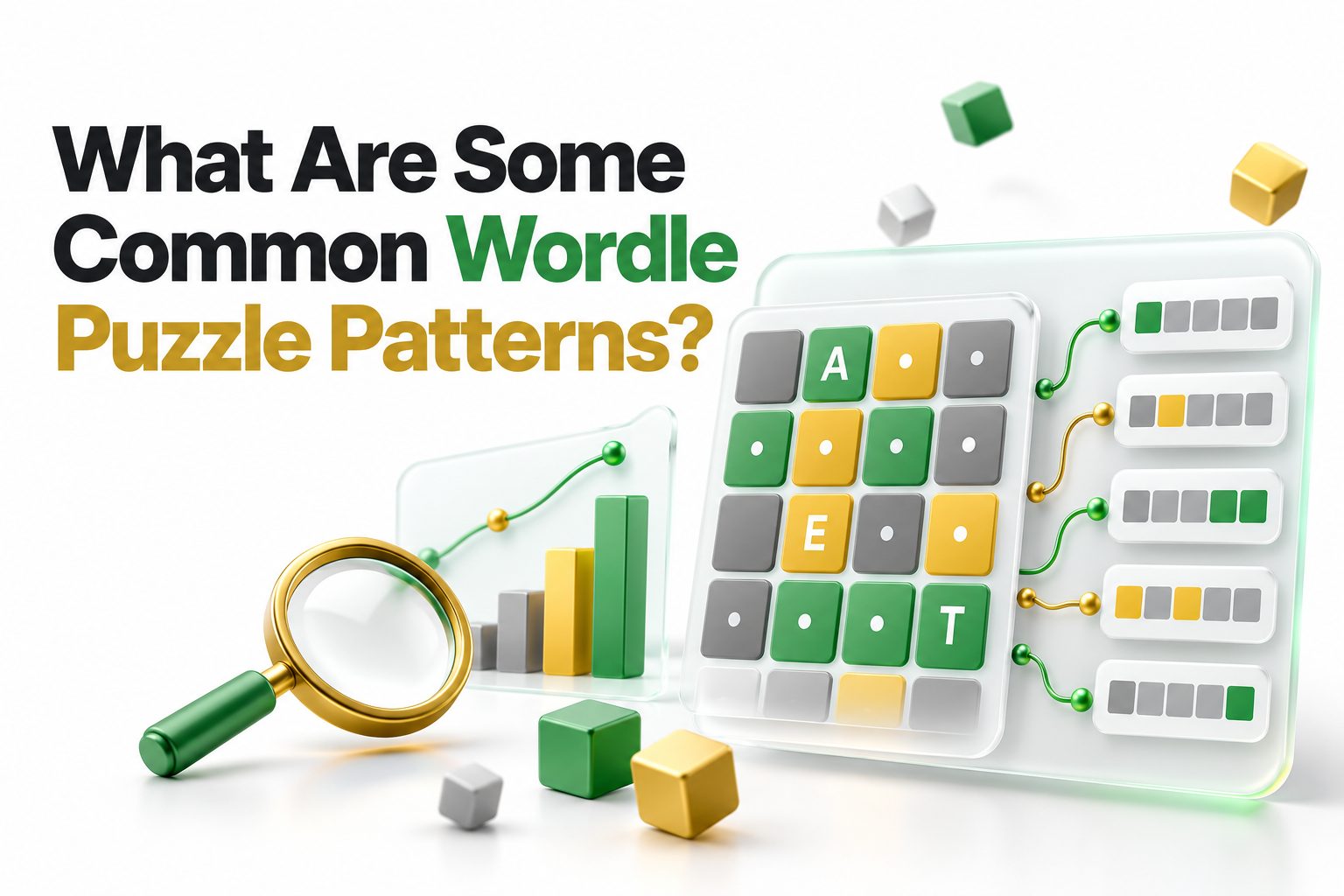
Wordle may use a simple five-letter grid, but its answers often follow recognizable spelling patterns. Spotting those patterns can help you turn scattered green and yellow tiles into a much smaller set of realistic possibilities. So, what are some common wordle puzzle patterns worth learning? The most useful include common consonant pairs, repeated letters, vowel combinations, silent letters, familiar word endings, and flexible letter clusters such as ST, CH, SH, and ER.
Pattern recognition does not replace careful guessing. It gives you a practical way to interpret feedback and avoid wasting attempts on letter combinations that rarely occur in English. For example, identifying _ATCH as a likely word family immediately suggests BATCH, CATCH, HATCH, LATCH, MATCH, PATCH, or WATCH. Knowing that a word may contain two copies of the same letter can also prevent a stalled solve.
This article explains the patterns that appear most often, shows how to test them efficiently, and covers common traps such as repeated letters and crowded word families. You will also learn a repeatable method for choosing guesses when several answers still fit.
Why Wordle Patterns Matter
Every Wordle guess provides two kinds of information: which letters belong in the answer and where those letters can appear. A pattern organizes that feedback into a familiar word structure. Instead of considering every five-letter word, you begin searching within a manageable family of plausible answers.
Patterns become especially valuable after the second or third guess. At that stage, you may have two confirmed letters and several excluded positions. Recognizing that the answer resembles _OUND, S_A_E, or _IGHT can narrow the field faster than simply choosing another word with common letters.
English spelling is not random. Certain vowels, consonants, prefixes, suffixes, and letter pairs occur together far more often than others. Wordle answers reflect those tendencies, even though the game occasionally selects less familiar vocabulary. Learning common structures therefore improves both speed and consistency.
Pattern knowledge also helps you separate likely answers from technically valid guesses. A strange letter arrangement might be accepted by the game without being a probable solution. Familiar spelling structures offer a useful reality check when your remaining options include obscure words.
Common Starting-Letter Patterns
Many five-letter words begin with two-consonant clusters. Common openings include ST, SP, SC, SH, CH, CR, TR, BR, BL, CL, FL, GR, PL, PR, and SL. When the first consonant is green, testing a compatible second consonant can reveal the word’s structure quickly.
The opening ST is especially flexible because it can precede several vowels and consonants. Words such as STARE, STEAL, STICK, STONE, STORE, STRAP, and STUDY illustrate how many structures can grow from the same beginning. A confirmed initial S should therefore prompt consideration of both vowels and consonant clusters.
Some starting patterns are strongly associated with particular continuations. QU is usually followed by a vowel, while TH often leads into combinations such as THE__, THI__, or THR__. A starting C may form CH, CL, CR, or a soft-C pattern before E or I.
Single-consonant openings should not be overlooked. Words like MAKER, RIVER, PANEL, TIGER, and HONEY begin with a consonant followed immediately by a vowel. If a cluster-heavy guess fails, switching to a consonant-vowel structure may expose the answer more efficiently.
Useful opening clusters include:
- BL, as in BLACK, BLAME, BLEND, BLIND, and BLOCK
- BR, as in BRAIN, BRAVE, BREAD, BRICK, and BROKE
- CH, as in CHAIN, CHARM, CHEST, CHILD, and CHUNK
- CL, as in CLAIM, CLEAN, CLERK, CLIMB, and CLOSE
- CR, as in CRANE, CRASH, CREAM, CRIME, and CROWD
- SH, as in SHADE, SHARE, SHEEP, SHIFT, and SHORE
- SP, as in SPACE, SPEAK, SPICE, SPOIL, and SPURN
- ST, as in STAIN, STEAM, STICK, STORM, and STUCK
- TR, as in TRACE, TREAD, TRIAL, TROPE, and TRUCK
Common Word Endings and Suffixes
Word endings are often easier to identify than beginnings because English relies heavily on recurring suffixes and final consonant combinations. Common Wordle endings include -ER, -ED, -LY, -AL, -EN, -ON, -ST, -CK, -CH, -SH, and -TH.
A confirmed final E deserves special attention. It may be pronounced, as in CRATE or SLICE, or silent, as in many consonant-vowel-consonant-E words. The silent E often changes the earlier vowel sound, producing families such as _AKE, _IDE, _ONE, and _UTE.
The ending -ER appears in words such as BAKER, BOXER, CIDER, HOVER, MAKER, and RIVER. When E and R are confirmed in the last two positions, the remaining letters may still create a large family. A good test guess should distinguish among candidates rather than merely repeat ER.
Final clusters also provide strong clues. An answer ending in CK will generally have a vowel immediately before it, as in BLACK, BRICK, CLOCK, QUICK, or TRUCK. Words ending in TCH typically place a vowel before that cluster, producing BATCH, CATCH, HITCH, NOTCH, and WATCH.
Vowel Placement Patterns
Most Wordle answers contain at least one traditional vowel, and many contain two. Their placement can reveal the basic shape of the word. Common structures include consonant-vowel-consonant-vowel-consonant, consonant-consonant-vowel-consonant-E, and consonant-vowel-vowel-consonant-consonant.
Vowel pairs such as AI, EA, EE, OA, OO, and OU appear regularly. Examples include CHAIN, DREAM, GREEN, ROAST, STOOL, and SOUND. When one vowel is yellow, consider whether it belongs beside another vowel rather than occupying an isolated position.
Y complicates vowel analysis because it can function like a vowel. Words such as CRYPT, GLYPH, NYMPH, SHYLY, and TRYST may contain no A, E, I, O, or U. More familiar examples such as CANDY, HAPPY, and STORY use Y in the final position.
A silent E can also make a word appear to have more active vowels than it does. In SHINE, for example, I carries the principal vowel sound while E modifies it. Recognizing this structure can help when E is green at the end but another vowel remains misplaced.
Repeated-Letter Patterns
Repeated letters are among the most common reasons otherwise strong Wordle solves go wrong. A gray tile does not always mean that a letter is absent. If the same letter appears twice in a guess, one copy may be gray because the answer contains only one instance.
Double consonants frequently occur in the middle of five-letter words. Examples include APPLY, CARRY, DIZZY, FUNNY, HAPPY, JELLY, PUPPY, and SORRY. Double vowels also appear in words such as CREEK, FLEET, GOOSE, SHEEP, and STOOL.
Repeated letters do not need to be adjacent. Words such as BANAL, CIVIC, EERIE, LEVEL, RADAR, REFER, and TENET repeat letters in separated positions. These arrangements are harder to notice because the grid may seem to point toward several different letters rather than one recurring character.
Once a letter is confirmed, testing a second copy can be worthwhile when the remaining structure supports it. Avoid doing so automatically, though. Repeating a known letter sacrifices the opportunity to test a new one, so the guess should be supported by realistic candidate words.
A practical repeated-letter checklist:
- Check whether the guess used the same letter more than once.
- Compare the colors of both copies rather than interpreting either tile alone.
- Count the minimum number of confirmed copies.
- Look for familiar double-letter locations, especially positions two and three or three and four.
- Consider separated repetition in symmetrical words such as LEVEL or RADAR.
- Test another copy only when it fits plausible remaining answers.
Silent Letters and Unusual Clusters
Some Wordle answers contain letters that are not obvious from pronunciation. Silent initial letters appear in words such as KNACK, KNEAD, KNEEL, and WROTE. Silent internal or final letters occur in CLIMB, DOUBT, NIGHT, RHYME, and WRONG.
These patterns matter because players often build possibilities by sound. If the answer appears to rhyme with “light,” limiting the search to phonetic spellings may cause you to miss FIGHT, MIGHT, NIGHT, RIGHT, SIGHT, or WIGHT. The GH cluster becomes obvious only when you think in written word families.
Unusual consonant clusters are less common, but they can become decisive after ordinary options are eliminated. PH appears in words such as GRAPH and NYMPH, while RH appears in RHYME. Initial GN and KN patterns are rare enough that they should usually be considered after more common structures.
Silent-letter words are difficult, but they are not arbitrary. Most belong to established families. Once _IGHT or KNE__ emerges, search the whole family rather than treating the letters as an isolated spelling oddity.
Flexible Word Families
A word family consists of several answers that share most of their letters. Wordle becomes particularly challenging when feedback leaves only one blank in a family such as _ATCH, _IGHT, _OUND, or _OWER. Multiple common words may fit, and guessing them one at a time can consume every remaining attempt.
The _ATCH family includes BATCH, CATCH, HATCH, LATCH, MATCH, PATCH, and WATCH. The _IGHT family includes EIGHT, FIGHT, LIGHT, MIGHT, NIGHT, RIGHT, SIGHT, and TIGHT. These families are often called traps because a correct pattern does not identify the missing letter.
Other crowded structures include _OUND, _ASTE, _OWER, _ILLS, and _AKES. The precise candidates depend on previous gray letters, but the strategy remains the same: list realistic possibilities before selecting the next guess.
A “burner” or elimination guess can test several possible initial letters at once. If _ATCH is confirmed and B, C, H, M, P, and W remain possible, a word containing several of those letters may provide more information than another direct _ATCH guess. The test word does not need to be a potential answer.
| Pattern | Example candidates | Main difficulty | Useful response |
| — | — | — | — |
| _ATCH | BATCH, CATCH, HATCH, MATCH, PATCH, WATCH | Many possible first letters | Test several initial letters together |
| _IGHT | FIGHT, LIGHT, MIGHT, NIGHT, RIGHT, SIGHT, TIGHT | Large rhyming family | Use exclusions before guessing directly |
| _OUND | BOUND, FOUND, HOUND, MOUND, POUND, ROUND, SOUND | Seven common openings | Choose a probe with multiple candidates |
| _OWER | COWER, DOWER, LOWER, MOWER, POWER, TOWER | Similar common answers | Test C, L, M, P, and T efficiently |
| _ASTE | BASTE, HASTE, PASTE, TASTE, WASTE | Limited attempts can vanish quickly | Avoid cycling through one letter at a time |
Consonant and Vowel Distribution
Strong Wordle solving depends on balance. Words with two vowels and three consonants are common, but they are not universal. Some answers contain one traditional vowel, while others contain three or more. Treating a preferred distribution as a rule can make unusual answers harder to see.
Early guesses benefit from common letters because they reveal broad information. Letters such as E, A, R, O, T, L, I, S, N, and C occur frequently in English words. Yet frequency alone is not enough; placement and compatibility matter just as much.
Once several letters are confirmed, candidate quality matters more than raw coverage. A guess containing five unused common letters may reveal little if none can fit the known pattern. At that stage, prioritize letters that distinguish among actual possibilities.
For more help choosing an efficient opener, see [Internal Link: Best Wordle Starting Words]. A good starting word should cover useful letters, but the best follow-up always depends on the color feedback from the current puzzle.
Positional Patterns Across Five-Letter Words
Certain letters favor particular positions. Y often appears at the end, while Q is commonly followed by U. E frequently occupies the final position, and common suffixes place R, T, D, or N near the end. These tendencies are useful guides rather than fixed rules.
Position also changes the value of a yellow tile. If R is yellow in the first position, it may belong in the middle of a cluster such as CR, TR, or BR, or near the end in -ER. Thinking about compatible neighbors is more effective than moving R randomly.
Green tiles should be treated as anchors. Build outward from them by considering which letters naturally precede and follow the confirmed sequence. A green A in position three creates different possibilities depending on whether positions two and four are likely consonants, vowels, or parts of clusters.
Gray tiles impose positional and numerical constraints. A letter can be absent entirely, or an extra copy may be gray because the word contains fewer instances than the guess. Record both facts carefully before creating a candidate list.
A Reliable Method for Reading Wordle Patterns
A structured process keeps you from overlooking obvious candidates or repeating an unhelpful guess. The goal is not to memorize every five-letter word. It is to translate tile feedback into constraints, identify likely structures, and choose the guess that separates the remaining options.
Use this method after each attempt:
1. Lock in every green letter.
Write the pattern using underscores for unknown positions, such as _ A _ E _. Do not move green letters mentally when testing possibilities.
2. Record every forbidden position.
A yellow letter belongs in the word but cannot remain where you placed it. Note each excluded position, especially when the same yellow letter has appeared in multiple guesses.
3. Separate absent letters from limited copies.
Gray letters are usually excluded. When a letter was repeated in the guess, determine whether the gray tile means “absent” or simply “no additional copy.”
4. Identify likely clusters and endings.
Look for common structures such as SH, CH, ST, -ER, -CK, -IGHT, or consonant-vowel-consonant-E. Use them to form a small candidate set.
5. List realistic answers.
Write down all common words that satisfy the evidence. Do not stop at the first word that comes to mind, particularly when the pattern belongs to a crowded family.
6. Choose between a solution guess and a test guess.
Guess a possible answer when only one or two strong candidates remain. Use an elimination word when several candidates differ in letters you can test together.
7. Recheck every tile before submitting.
Confirm that the word uses all known letters, respects yellow exclusions, keeps greens fixed, and avoids eliminated letters.
Pattern-Based Guessing Versus Letter-Frequency Guessing
Letter-frequency guessing aims to test common letters, especially early in the puzzle. Pattern-based guessing focuses on how known letters combine. Both methods are valuable, but they work best at different stages of a solve.
The opening guess is primarily a coverage exercise. After feedback appears, the problem changes. A high-frequency word that ignores known positions may be less useful than a lower-frequency word that tests two plausible clusters or separates several candidates.
| Situation | Better approach | Reason |
| — | — | — |
| First guess | Letter frequency | No structural evidence exists yet |
| Few letters found | Broad coverage | More vowels and consonants need testing |
| Two or more greens | Pattern recognition | Confirmed positions define likely families |
| Crowded word family | Elimination guess | Several candidate letters can be tested together |
| One likely answer remains | Direct solution guess | Extra testing would waste an attempt |
The most effective players switch methods as the puzzle develops. They begin broadly, then become increasingly specific. This shift prevents two common errors: forcing a pattern too early and continuing to chase letter coverage after the word’s structure is already visible.
Common Pattern-Recognition Mistakes
The first mistake is assuming every letter appears only once. Repeated letters are common enough that they should remain possible whenever the structure supports them. A puzzle with one confirmed E may still contain another E elsewhere.
Another mistake is treating yellow letters as movable without restrictions. A yellow tile confirms both presence and a forbidden position. Forgetting that second piece of information leads to guesses that cannot possibly be correct.
Players also overcommit to familiar endings. If the pattern is _ A _ E _, it may be tempting to assume the word ends in ER or ED. That assumption can hide alternatives such as PANEL, HAVEN, or CAMEO, depending on the available letters.
Rhyming traps cause unnecessary losses as well. Once four letters are green, repeatedly cycling through possible first letters feels logical. It is often inefficient when four or more candidates remain. An elimination guess can test several openings in one turn.
Common mistakes to avoid:
- Reusing a gray letter without a repeated-letter reason
- Moving a green tile while imagining candidates
- Forgetting the excluded position of a yellow letter
- Assuming every answer contains two traditional vowels
- Choosing obscure accepted words over likely solutions
- Guessing through a large word family one candidate at a time
- Ignoring Y as a possible vowel
- Forcing a familiar suffix before enough evidence supports it
Improving Pattern Recognition Through Practice
Pattern recognition improves when you review the structure of solved words rather than focusing only on your score. After each puzzle, identify its opening cluster, vowel arrangement, ending, repeated letters, and any misleading features. This takes less than a minute and builds useful spelling awareness.
Grouping words into families is another effective exercise. Make short lists for structures such as _IGHT, _OUND, _ATCH, _AKE, _ORE, and _ILL. The aim is not rote memorization; it is learning to recognize when a family is crowded enough to require an elimination strategy.
Word games, crosswords, and targeted vocabulary practice also help. They expose you to legal letter combinations and less obvious spellings. A broader vocabulary makes it easier to notice possibilities, though common words should still receive priority when evaluating likely Wordle answers.
You can also review [Internal Link: Common Five-Letter Words] to become familiar with recurring clusters and endings. Focus on spelling structures rather than memorizing an answer list, since pattern skills remain useful across different Wordle-style games.
Practical Examples of Pattern Solving
Suppose your first guess reveals that A is yellow, E is green in position five, and R, S, and T are gray. Your pattern is _ _ _ _ E, with A somewhere in the first four positions. Possible structures include _ A _ _ E and _ _ A _ E.
A second guess might reveal A in position three and L as yellow. You now have _ _ A _ E, with L present but excluded from its tested position. Words such as BLAME, FLAME, GLADE, PLACE, PLANE, and CLAVE may come to mind, but previous gray letters and L’s forbidden position will remove many options.
Consider a different case where the result is _ I G H T after three guesses. Several common solutions remain: FIGHT, LIGHT, MIGHT, NIGHT, RIGHT, SIGHT, and TIGHT. Directly guessing one candidate offers poor odds if most initial letters are untested.
A probe word containing several possible initials may be stronger. For example, a valid test using F, L, M, N, R, S, or T can eliminate multiple options at once. The exact choice depends on which letters have already been ruled out and which valid guesses are available.
A repeated-letter example works differently. Suppose the pattern is _ E _ E _ and several consonants are excluded. LEVEL, REFER, RENEW, and TENET demonstrate why a second E should remain under consideration. Counting tile colors carefully will tell you whether two or three copies are possible.
Adapting Patterns to Hard Mode
Hard Mode requires you to use revealed hints in later guesses. Green letters must stay in place, and yellow letters must be included. This restriction can make elimination guesses harder because you cannot freely choose a word containing several unrelated candidate letters.
The mode rewards earlier planning. When a large family begins to emerge, test likely branching letters before locking four positions in green. Once _IGHT is fixed, Hard Mode may force you to guess through the remaining family one word at a time.
Repeated letters also require caution in Hard Mode. A revealed letter must be reused, but the interface may not communicate every count constraint as clearly as a player expects. Continue interpreting duplicate tiles manually rather than assuming the mode has resolved the number of copies for you.
When choosing between two plausible early guesses, favor the one that tests letters likely to distinguish future candidates. This is less dramatic than solving immediately, but it reduces the risk of becoming trapped in a crowded family.
Quick Tips for More Efficient Solves
Pattern knowledge works best when paired with disciplined guess selection. The following habits help preserve attempts and keep the candidate set accurate:
- Use the first two guesses to gather information unless the pattern becomes obvious sooner.
- Treat green letters as fixed anchors and yellow letters as position-specific clues.
- Check for repeated letters when a nearly complete pattern has no obvious answer.
- Scan common endings before considering rare vocabulary.
- List candidates before choosing among a crowded family.
- Use elimination guesses when they can test three or more branching letters.
- Prefer likely answer words over obscure but accepted guesses.
- Remember that Y can supply the main vowel sound.
- Reassess assumptions when a familiar pattern produces no valid candidates.
- Slow down before submitting; many failed attempts come from overlooking an existing gray letter.
Conclusion
Common Wordle patterns include familiar opening clusters, recurring suffixes, vowel pairs, silent-E structures, repeated letters, and crowded families such as _IGHT, _ATCH, and _OUND. Recognizing these forms turns tile feedback into a practical framework for narrowing the answer instead of relying on random vocabulary recall.
The best approach changes as the puzzle develops. Begin with useful letter coverage, then shift toward positional patterns once green and yellow tiles reveal the word’s shape. Count duplicate letters carefully, respect every forbidden position, and avoid guessing through a large rhyming family one word at a time. When several solutions remain, an elimination guess may provide more value than a direct attempt.
If you have been wondering what are some common wordle puzzle patterns, focus first on consonant clusters, standard endings, vowel placement, and repeated-letter behavior. Those categories appear often and are easy to apply. With practice, you will begin to see entire word families in the grid, making your guesses more deliberate, efficient, and reliable.
Frequently Asked Questions
What is the most common Wordle word structure?
A consonant-vowel-consonant pattern with another vowel or final silent E is very common. Still, Wordle uses varied structures, so treat this as a tendency rather than a rule for every puzzle.
How can I spot repeated letters?
Check whether a familiar pattern has too few viable answers and compare duplicate tiles carefully. One colored copy plus one gray copy often means the answer contains that letter exactly once, not that it is absent.
Which word endings appear often?
Common endings include -ER, -ED, -AL, -EN, -CK, -CH, -SH, and -TH. Silent-E families such as -AKE, -IDE, and -ORE also appear regularly in five-letter words.
What should I do with a word family trap?
List every plausible candidate and identify the letters that differ. If several remain, use an elimination word containing multiple candidate letters instead of testing possible solutions individually and exhausting your attempts.
Does every Wordle answer contain a vowel?
Most contain A, E, I, O, or U, but not every answer requires one of those letters. Y can function as the vowel sound in words such as CRYPT, GLYPH, and TRYST.